Ultra-bright nanoparticles enable detection of nearly identical molecules at trace levels
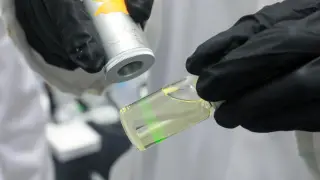
Engineers at the University of Toronto developed dye-sensitized nanoparticles that upconvert low-energy photons to higher-energy ones, producing bright green luminescence when excited by near-infrared light. These particles can detect extremely low concentrations of chemicals and distinguish between molecules with similar shapes. The technology could aid pharmaceutical impurity testing and environmental pollutant monitoring, according to a paper in the Journal of the American Chemical Society.
The nanoparticles employ a layered architecture: organic dye molecules on the surface capture near-infrared light first, then transfer that energy to ytterbium and erbium ions embedded within a sodium-yttrium-fluoride host crystal. This arrangement, which the researchers compare to icing atop a chocolate-chip cookie, enables the upconversion process that yields the bright green emission.
Earlier versions of such sensing particles were typically flat hexagonal structures with the lanthanide ions distributed throughout the host material. The new dye-sensitized design markedly boosts brightness. Because the excitation light (near-infrared) and emitted light (green) occupy different frequencies, background interference from samples is virtually eliminated, allowing detection of vanishingly small chemical traces and discrimination between nearly identical molecular shapes.
This technology could make trace chemical detection more accessible and affordable across multiple sectors. Pharmaceutical manufacturers may use it to catch dangerous drug impurities before products reach patients, potentially reducing recall risks and safeguarding public health. Environmental agencies could monitor groundwater for pollutants at concentrations previously requiring expensive laboratory equipment. Since the particles work with low-cost lasers, smaller laboratories and developing regions might gain testing capabilities once reserved for well-funded institutions, though field deployment, scalability, and regulatory validation remain open questions.