Quantum entanglement persists in Z boson pairs at LHC energies
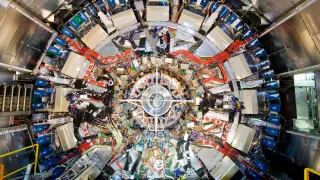
Using the ATLAS experiment at CERN, physicists found strong evidence of entanglement between Z bosons produced in Higgs boson decays. This demonstrates that quantum correlations survive at energies far beyond previous tests, confirming Einstein's 'spooky action' under extreme laboratory conditions.
The ATLAS detector reconstructed Z boson spins by tracking the angles of electrons and muons produced in their decays. Higgs bosons, created from proton collisions at thirteen trillion electron volts, briefly transform into Z boson pairs before those particles vanish almost instantly. This approach extends entanglement tests from relatively stable systems like photons and trapped ions to particles existing for mere fractions of a second.
Professor Alan Barr of Oxford helped pioneer the idea of using particle colliders for entanglement research, building on his earlier work constructing the LHC. His suggestions contributed to a 2023 ATLAS experiment that laid groundwork for this measurement. The finding demonstrates that quantum correlations persist at energy scales vastly exceeding those of conventional laboratory experiments.
This result could strengthen confidence in quantum information technologies by showing entanglement survives extreme conditions, though practical applications remain distant. Physicists may use these methods to probe fundamental questions about quantum mechanics at high energies, potentially refining theoretical models. Society could benefit indirectly through advances in quantum computing and secure communications, as researchers gain deeper understanding of how entanglement behaves under conditions previously untested. The work may also inspire educational interest in quantum physics.