Quantum light 'swimmer' defies action-reaction principle to move upstream
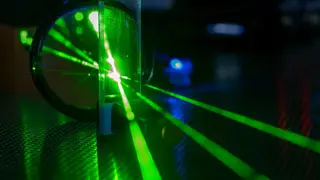
Physicists demonstrated that a passive beam of quantum light can move upstream against a quantum fluid of light, violating Newton's third law. The interaction between the swimmer and the river was non-reciprocal, producing an upstream force without expending energy. This could enable new methods for controlling quantum light in experiments and devices.
The experiment involved constructing a quantum fluid by directing lasers through a voltage-exposed crystal, causing photons to interact and form a river-like medium. A second light beam, shaped as a solitary wave, served as the swimmer. Unlike previous demonstrations where upstream motion depended on vortex creation and recoil, this mechanism relied purely on asymmetric forces between the two light systems.
The non-reciprocal interaction meant the swimmer felt attraction while the river felt repulsion, generating net upstream force without energy expenditure. This contrasts with conventional active matter systems—bacterial mixtures, bird flocks, robot swarms—which require energy consumption. The work suggests passive objects can exhibit active behavior in quantum settings, potentially opening new approaches for photonic device control.
This demonstration could reshape how quantum light is manipulated in practical technologies. Communications systems and quantum information processing devices may eventually benefit from directional control of light without energy input, potentially improving efficiency. The work may also influence how researchers conceptualize active matter, extending its principles into quantum domains. However, laboratory demonstrations remain far from commercial application, and significant engineering challenges would need addressing before any real-world deployment becomes feasible.