Curved Parthenon platform may not create intended straightening effect, mathematician argues
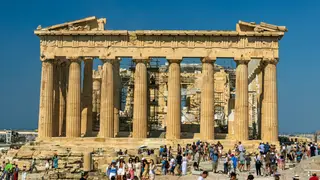
A new mathematical analysis challenges the long-held theory that the Parthenon's subtly curved platform creates an optical illusion making the structure appear straighter. The study shows that the curve's maximum height of six centimeters would be visible from 25 meters only under ideal conditions, and real-world visual noise would obscure it. Thus, the intended illusion likely fails for most viewers.
The stylobate's curvature is a deliberate architectural feature, but its perceptual impact is now under scrutiny. Goriely's analysis relies on established thresholds for human curve detection—roughly 1.5 to five centimeters at a 25-meter distance—compared against the platform's actual six-centimeter maximum rise. Crucially, he argues that real-world viewing conditions introduce visual noise from the three-dimensional columns and surrounding elements, which masks the subtle curve even at that optimal distance. This suggests the effect would be imperceptible to most observers in practice.
The paper also examines classical geometric illusions, such as the Hering and Wundt effects, where intersecting lines distort perceived straightness. The Parthenon's columns, despite their slight inward tilt and central bulge, are nearly perpendicular to the stylobate, which would nullify any such illusion mechanism. Goriely further highlights a logical paradox: if the curve were designed to make the structure appear straight, its visibility at close range would undermine that very purpose, leaving the theory internally inconsistent.
This challenge to a long-standing architectural theory could reshape how historians, architects, and tourists interpret the Parthenon's design. It may shift scholarly focus from optical correction toward alternative explanations, such as structural drainage or purely aesthetic expression. Public understanding of ancient engineering could become more nuanced, recognizing that classical builders may have prioritized practical or symbolic choices over sophisticated perceptual tricks. This analysis could also prompt re-evaluation of similar claims about other ancient structures, potentially altering museum narratives and educational materials.