ISS snapshot uncovers snowy-looking salt slab on Chad's Emi Koussi volcano
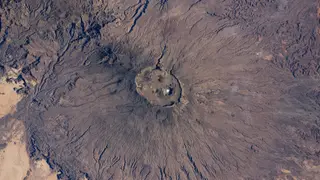
An astronaut aboard the International Space Station photographed a bright white salt deposit on the summit of Emi Koussi, an extinct volcano in Chad. The volcano, which rises over 11,000 feet, is the tallest peak in the Sahara and is covered with ancient lava flows. The salt patch, located in the caldera, is often mistaken for snow by astronauts.
The natron crust inside Era Kohor crater measures up to 3,300 feet across and several feet thick, formed when an ancient saline lake evaporated completely. This mineral blend contains sodium carbonate decahydrate, sodium bicarbonate, sodium chloride, and sodium sulfate. The volcano's slopes carry lava flows estimated at roughly two million years old, which scientists believe moved with unusually low viscosity. A similar natron deposit exists at Trou au Natron, about 150 miles northwest, where salt formations and volcanic cones create a skull-like appearance. Despite the region's extreme aridity, the caldera complex also harbors hidden waterways that remain largely shadowed from view.
This discovery could reshape public understanding of volcanic landscapes in extreme environments, showing that even extinct peaks can harbor surprising mineral features. Researchers studying similar arid volcanic systems may find useful comparisons for interpreting salt deposits elsewhere, including on other planets. The imagery also offers educational value, helping students and casual readers grasp how geological processes like evaporation and volcanic activity interact over millions of years. However, the remote location limits direct economic or practical applications, so the primary impact remains scientific and observational rather than commercial.