Federal Court Overturns Rules Limiting Capitol Steps Demonstrations
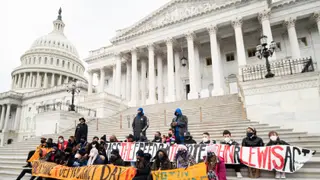
A federal appeals court in Washington ruled that U.S. Capitol Police restrictions on demonstrations on the Capitol's eastern steps violate the First Amendment. The 2-1 decision found the rules, which generally ban protests unless sponsored by members of Congress, give government arbitrary control over speech. The case was sent back to a lower court for further proceedings.
The ruling stems from a 2021 arrest of minister Patrick Mahoney, who protested on the Capitol’s eastern steps. The appeals court majority classified the steps as a “nonpublic forum,” yet still found the Capitol Police Board’s post-9/11 rules—which generally require congressional sponsorship for demonstrations—unconstitutionally arbitrary because they grant lawmakers effective control over access. The case now returns to the district court for further review, leaving the immediate status of the steps unchanged. Judge Judith Rogers dissented, emphasizing the steps’ historical use as a public speaking venue, not merely an entrance.
This decision could reshape how protest access is managed at the Capitol, potentially opening the eastern steps to more spontaneous demonstrations while still allowing some restrictions. It may affect activists, religious groups, and political organizers who previously needed congressional sponsorship, and could prompt police to craft more neutral rules. The ruling’s impact may extend to other government properties where speech is regulated, though the nonpublic forum designation limits its reach. Society could see a modest expansion of expressive rights, balanced against security concerns that have dominated Capitol policing since 9/11.