Quadruped Robot Finishes 26.2-Mile Race Without Recharging
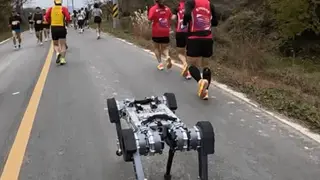
A four-legged robot named RAIBO2 completed a full marathon in 4 hours, 19 minutes and 52 seconds on a single battery charge, beating the average human finishing time. Researchers at KAIST identified energy losses in motors, gears, and foot impacts, then redesigned the robot to reduce waste and recover energy on downhill sections. The control algorithm was trained via reinforcement learning to minimize slipping and overheating, as detailed in a study published in Nature.
The KAIST team's efficiency gains came from a systematic audit of energy waste. Roughly two-thirds of power dissipated as heat in motors and electronics, while the remainder was lost to gear friction, foot slippage, and impact shocks. Their fixes included lighter legs, redesigned motor controllers, and a larger battery, all while maintaining torque output.
The robot's gait was refined through reinforcement learning, rewarding soft landings and preventing overheating or slips. It also harvests energy on descents. Currently, RAIBO2 requires a human operator for steering, as its camera lacks onboard interpretation. Researchers are developing smaller sensors and networks to add autonomy without significant power penalties.
This breakthrough could extend the operational range of quadruped robots in disaster response, inspection, and delivery, where battery life is a critical constraint. It may also spur advances in energy-efficient actuators and control algorithms, potentially benefiting prosthetics and exoskeletons. However, the current need for remote steering limits immediate real-world use. As autonomy improves without power penalties, these machines could become more practical for long-duration tasks, though societal adoption will depend on reliability and cost.