Developer documentation placeholder domain weaponized for ClickFix malware campaign
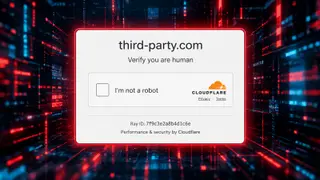
The domain third-party.com, widely used as a placeholder in developer guides and code samples, now displays a fake Cloudflare verification page that tricks Windows users into running a malicious PowerShell command. This ClickFix technique copies a payload URL and instructs victims to paste and execute it, potentially bypassing antivirus defenses. The attack chain was partially broken at testing time, but a prior sample shows it delivered a large archive from a related domain.
The attack exploits a trust gap: unlike example.com, which IANA reserves for documentation, third-party.com is a real registered domain whose owner can change its content at will. Developers have long referenced it in W3C specifications and Chromium documentation, making it a familiar sight in code samples and iframe examples.
The ClickFix technique relies on social engineering rather than technical exploits. The fake Cloudflare check copies a PowerShell command to the clipboard, then instructs users to open the Run dialog and execute it manually. The current payload domain no longer resolves, but a May 2026 sample showed a 134MB archive that extracted and launched draw.io.exe. Linux and macOS visitors see only an unsupported-OS error, meaning scanners on those platforms detect nothing suspicious.
This campaign could undermine trust in developer documentation and code examples, as professionals who copy placeholder domains into projects may unknowingly reference a compromised resource. Organizations relying on such documentation for internal tooling could face malware exposure if employees follow the fake verification prompts. The attack's targeting of Windows users specifically suggests a deliberate focus on enterprise environments, where PowerShell execution is common. If similar placeholder domains are compromised, the broader developer community may need to reassess assumptions about which example domains are safe to reference.