Falcon 9 sends another Starlink batch into orbit from California coast
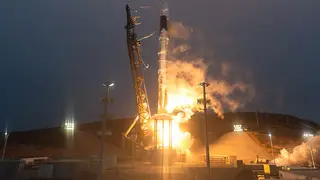
A Falcon 9 lifted off from Vandenberg Space Force Base on Sept. 19, carrying 27 V2 Mini satellites on the Starlink 15-27 mission. The booster B1093 completed its 17th flight and landed on a droneship in the Pacific Ocean. This was the 81st Starlink mission of the year.
The mission marked the 81st Starlink launch of 2026, continuing a rapid cadence that has become routine for SpaceX. Booster B1093 demonstrated its reusability with a 17th flight, having previously supported two Space Development Agency missions, a Transporter rideshare, and 13 Starlink deployments. Its landing on the droneship *Of Course I Still Love You* was the 225th for that vessel and the 662nd Falcon booster recovery overall. The 27 V2 Mini Optimized satellites deployed about an hour after liftoff, adding to a constellation that now numbers in the thousands.
The launch from Vandenberg’s SLC-4E followed a southeasterly trajectory along the California coast, making the early-evening liftoff visible to a wide population. This flight was the 15th Starlink mission in the 15-27 group designation, reflecting a systematic expansion of orbital capacity. Each V2 Mini satellite carries enhanced throughput and is designed for eventual deorbit, supporting SpaceX’s goal of global broadband coverage while managing space debris.
This launch could further entrench Starlink as a dominant low-Earth-orbit internet provider, potentially widening access in rural and underserved regions. However, the rapid deployment may also intensify concerns about orbital congestion and light pollution, affecting astronomers and satellite operators. As the constellation grows, regulatory and safety frameworks may need to adapt, influencing how future mega-constellations are managed. Society could benefit from improved connectivity, but trade-offs around space sustainability and equitable access remain open questions.