Ground-penetrating scans suggest hidden chambers near Tutankhamun's tomb
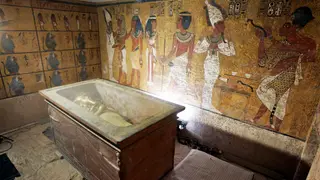
Recent surveys beneath the Valley of the Kings indicate a larger structure extending beyond Tutankhamun's tomb, designated KV 62. The tomb's unusually small size and layout have long puzzled archaeologists, prompting theories of additional burial spaces. These findings align with Nicholas Reeves' hypothesis that hidden chambers may be connected to Queen Nefertiti.
Ground-penetrating surveys conducted beneath the Valley of the Kings have revealed what appears to be a more extensive structure lying beyond the boundaries of Tutankhamun's tomb, catalogued as KV 62. The tomb's notably compact dimensions and unconventional floor plan have long stood as an anomaly among royal burials, leaving researchers to question whether the space was originally intended for a different purpose or occupant.
These new findings lend fresh weight to an earlier proposal by archaeologist Nicholas Reeves, who has argued that concealed chambers linked to the tomb may connect to the burial of Queen Nefertiti. If confirmed, such spaces could reshape understanding of the late Eighteenth Dynasty's royal funerary practices and the political dynamics of that era.
This discovery could reignite public fascination with ancient Egypt, potentially boosting heritage tourism and funding for non-invasive archaeological methods. It may also prompt scholarly debate about the reliability of remote sensing in burial contexts, affecting how future excavations are prioritized. For historians, confirmation could alter narratives around Nefertiti's fate, though the evidence remains preliminary.