Solar Sail Deflection Technique Could Strike Asteroids at 100 km/s
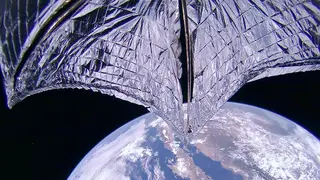
Researchers at Beihang University propose using a diffractive solar sail to intercept an asteroid head-on, achieving impact speeds around 100 km/s. This would transfer far more energy than the DART mission's 6 km/s impact, potentially deflecting hazardous asteroids with less warning time. The approach overcomes the challenge of reversing orbital direction by using solar sail propulsion.
The Beihang proposal leverages the physics that kinetic energy grows with the square of velocity. A head-on intercept at roughly 100 km/s would deliver about 230 times more energy per kilogram than DART's 6 km/s rear-approach impact, potentially requiring far less warning time to deflect a hazardous asteroid.
Achieving that retrograde trajectory is the hurdle. Chemical rockets cannot carry enough fuel to reverse orbital direction. Solar sails, however, use photon pressure. Giancarlo Vulpetti's H-reversal technique involves braking angular momentum, diving toward the Sun, then slingshotting outward into a retrograde orbit. Traditional mirror-like sails are clumsy for this maneuver, prompting the diffractive sail concept.
This technique could dramatically shorten the lead time needed for asteroid deflection, potentially shifting planetary defense from a decade-long planning cycle to a matter of months. If realized, it may give humanity a more robust response option, but it also relies on unproven solar sail maneuvering. Success could reassure the public, yet it may also foster overconfidence in our ability to handle any threat, underscoring the need for continued asteroid tracking.