Square Kilometre Array Could Reveal Exoplanet Magnetic Fields
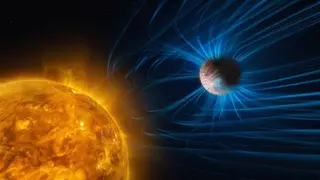
An international team suggests the Square Kilometre Array (SKA) could detect radio emissions from exoplanets' aurorae, indicating magnetic fields. The study builds on decades of radio observations of ultracool dwarfs to model how SKA might characterize exoplanet magnetic fields and radiation belts. This would help identify Earth-like worlds shielded from stellar radiation.
The SKA's interferometric approach would combine signals from multiple telescopes, while astrometry would track stellar movements to identify planets only slightly more massive than Earth orbiting ultracool dwarfs. These methods build on decades of radio observations of these small, cool objects, which have already yielded detectable auroral emissions.
Beta Pictoris b, roughly 10-12 Jupiter masses and orbiting at 10 AU, recently produced radio signals suggesting a magnetic field. The researchers propose that targeted monitoring of promising systems and known radio-emitting dwarfs could reveal exoplanet radiation belts and even potential exomoons, offering new insights into planetary formation and evolution.
The ability to identify magnetic fields on exoplanets could reshape how scientists prioritize targets in the search for habitable worlds. Planets with protective magnetic fields may be better candidates for hosting life, as they would be shielded from harmful stellar radiation. This could influence future telescope time allocations and mission planning, potentially accelerating the discovery of Earth-like planets. Society may benefit from a clearer understanding of which nearby worlds merit deeper investigation, though actual detections remain years away.