Interstellar Comet 3I/ATLAS Shows Unusual Isotope Ratios
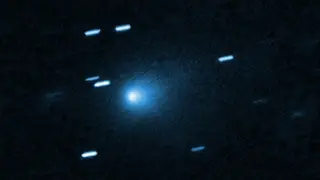
Observations of interstellar comet 3I/ATLAS reveal high carbon isotope ratios and a deuterium-to-hydrogen ratio of about 1% in its water, far exceeding typical solar system comets. Researchers attribute these anomalies to the comet's origin in a low-metallicity stellar nursery. The findings are detailed in a paper submitted to The Astrophysical Journal Letters.
The interstellar comet 3I/ATLAS, discovered in July 2025, shows a carbon isotope ratio (C-12/C-13) between 123 and 191—far above the solar system's ~90 and the interstellar medium's ~68. Its water also has a deuterium-to-hydrogen ratio near 1%, versus 0.015–0.03% for typical local comets. The findings appear in a paper submitted to The Astrophysical Journal Letters.
Researchers led by Kenji Furuya attribute these anomalies to formation in a low-metallicity stellar nursery. They simulated water ice's lifecycle, focusing on deuterium fractionation—driven by cosmic rays creating H3+ ions, which react with HD to form H2D+ at frigid temperatures near 10 Kelvin. This cold chemistry, combined with low metal content, explains the extreme isotope enrichment.
This finding could reshape models of how comets and planetary systems form, particularly in low-metallicity environments. It may also refine techniques for interpreting isotopic data from future interstellar visitors, potentially informing searches for habitable exoplanets. For the public, it underscores the diversity of cosmic chemistry, possibly boosting interest in space science. However, immediate practical effects are minimal, with impact largely confined to academic research and educational outreach.