Five Supernova Remnants Shine in a Single Vast Sky Image
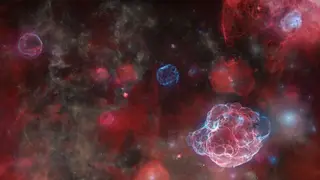
A new astronomical image from Oukaïmeden Observatory in Morocco shows five supernova remnants in the constellation Auriga, spanning an area equivalent to a thousand full moons. The remnants, including the Spaghetti Nebula, are at various distances and ages, with some possibly visible to early humans as bright stars. The image required about 200 hours of observation time.
The five remnants span a sky region roughly the size of a thousand full moons, yet each originated from a separate stellar explosion at distances up to several thousand light-years. Their ages range to tens of thousands of years, meaning some outbursts could have been witnessed by early humans as temporary “new stars” that faded over months. The image’s red hydrogen and blue oxygen emissions trace shocked gas shells and delicate filaments, while the annotated version also pinpoints open cluster M37 and the Tadpole Nebula as useful celestial landmarks. Observers invested about 200 hours at Oukaïmeden Observatory to capture this wide-field view, highlighting the faint, extended nature of these ancient debris clouds.
This image may deepen public appreciation for the slow, violent evolution of our galaxy, showing that supernova remnants are not isolated events but part of a larger celestial tapestry. Amateur astronomers and educators could use the annotated version to identify these objects, fostering engagement with astrophysics. The sheer observation time also underscores the patience required for deep-sky imaging, potentially inspiring citizen-science projects. However, its direct societal impact remains limited to inspiration and education, with no immediate technological or economic consequences.