AI 'Mental Simulations' Could Revolutionize Spacecraft Docking
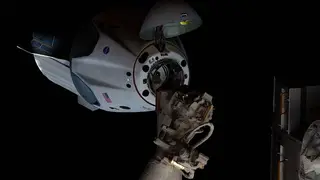
Researchers at Stanford have developed an AI system called the Out-of-this-World-Model (OWM) that uses mental simulations to guide spacecraft docking with the ISS. Traditional navigation relies on hard-coded physics and Kalman filters, which struggle with high-speed video and lighting changes. The new approach aims to make docking safer and more adaptable by learning from simulated scenarios.
The OWM departs from conventional GNC algorithms and Kalman filters, which struggle with high-speed video and lighting shifts. It also overcomes a key weakness of reinforcement learning, which fails when mission parameters change, such as a different docking port orientation. Instead, the model learns environmental physics from experience, using a baseball outfielder's predictive instinct as an analogy.
Training this model demands hundreds of thousands of simulated flights, a task that would take weeks on a standard CPU, highlighting the need for substantial computational resources. The system evaluates the probability of each "dreamed" outcome, allowing it to adapt when actual results deviate from predictions. This probabilistic approach is central to its robustness.
This technology could significantly enhance the safety and autonomy of orbital rendezvous, reducing risks for crewed missions and enabling more complex operations like satellite servicing or debris removal. It may also lower the barrier for smaller space actors by making docking less reliant on specialized human pilots. However, reliance on AI for critical maneuvers will require rigorous validation and trust-building, potentially affecting regulatory standards for autonomous spacecraft.