Proposal: Carry Native NoC Packets Across Die Boundaries
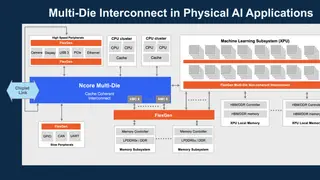
The article discusses the shift from monolithic SoCs to chiplet-based architectures, driven by AI workloads that require continuous high-volume data flow. It argues that current coherent interconnect protocols are mismatched to AI accelerator traffic patterns. A new approach is proposed: transporting the native packetized NoC traffic directly across die boundaries using a stable, invariant interface.
The article highlights how physical AI systems—autonomous vehicles, industrial robots, drones, and manufacturing platforms—generate communication patterns fundamentally different from traditional processors. Rather than exchanging individual cache lines, these systems move continuous streams of feature maps, tensors, point clouds, video frames, and intermediate inference results between specialized accelerators, often in volumes of hundreds of kilobytes or megabytes at deterministic rates.
Coherent die-to-die protocols remain effective for processor-centric workloads such as large SMP systems, CPU memory access, synchronization, and control-plane communication. However, the article argues these protocols divide communication into cache-line-sized transactions, which are inefficient for the high-volume, dataflow-style traffic that AI accelerators produce. The proposed alternative is a stable, invariant interface that carries native NoC packets directly across die boundaries, avoiding protocol translation overhead.
This proposal could reshape how autonomous vehicles, robotics, and industrial systems are architected, potentially enabling more efficient multi-die designs that handle real-time AI workloads with lower latency and power consumption. If adopted, it may accelerate deployment of physical AI in safety-critical applications, affecting manufacturers, consumers, and infrastructure planners. However, the industry's shift away from established coherent protocols could create fragmentation, and adoption will depend on ecosystem support, standardization efforts, and proven reliability in production environments.