Einstein Probe discovers longest X-ray trail from pulsar
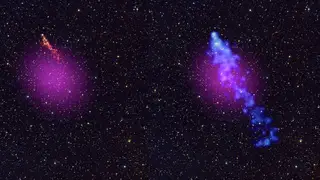
Astronomers using China's Einstein Probe satellite and LHAASO have found a 42-light-year-long X-ray trail around pulsar PSR J1740+1000, the longest ever seen from a pulsar wind nebula. The trail's particles appear to move in a specific direction, matching ultrahigh-energy gamma-ray emissions detected by LHAASO. The findings were published in Science China: Physics, Mechanics & Astronomy.
The pulsar PSR J1740+1000 sits roughly 4,600 light-years from Earth, and the Einstein Probe spent about 70,000 seconds tracking its extended emission. This trail's particles maintain a coherent direction over vast distances rather than dispersing randomly, which challenges standard assumptions about how cosmic rays behave in interstellar space.
Scientists propose two mechanisms for this focused flow: either a highly ordered interstellar magnetic field acts like a track guiding particles, or a narrow, fast outflow from the nebula itself channels them. Both possibilities remain unconfirmed, but the observations provide rare direct evidence of high-energy particle transport away from their acceleration site.
This discovery could reshape how scientists model cosmic ray propagation, which underpins understanding of galactic magnetic fields and high-energy astrophysics. It may also inform future telescope design and observation strategies, as the Einstein Probe's extended viewing proved crucial. For society, this deepens fundamental knowledge of the universe's most extreme environments, potentially inspiring educational interest in space science and advancing technologies tied to X-ray and gamma-ray detection.