Smart backpack detects muscle fatigue and delivers targeted massage
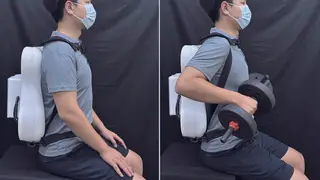
Engineers developed a wearable backpack that monitors electrical activity in back muscles and automatically massages fatigued areas. In a test with 15 participants, the device adjusted massage force based on fatigue levels, and seemed to aid recovery better than standard massages or heat therapy. The system aims to provide personalized relief for back pain.
The prototype integrates skin-contact electrodes that track electrical signals across four back muscle groups, with a movable massage head guided by cable mechanisms. Sensor feedback lets the system modulate pressure in real time based on detected fatigue levels. In testing, 15 healthy adults aged 20 to 26 performed seated dumbbell lifts to induce rhomboid fatigue. Post-treatment measurements showed muscle electrical activity roughly 2.6 times higher than after standard programmed massage, 1.9 times higher than heat therapy, and four times higher than rest alone. Researchers at the Wuhan Institute of Technology led the work, though outside experts noted the current device remains too heavy and bulky for practical workplace use, viewing it primarily as a promising proof of concept.
This technology could eventually offer personalized, on-demand relief for the roughly one in six adults experiencing back pain, particularly those in physically demanding jobs involving repetitive motion. If refined into lighter, more compact forms, it may reduce reliance on standardized treatments like massage chairs or heat pads that fail to address individual muscle issues. However, widespread adoption likely remains years away, and its real-world effectiveness beyond controlled lab conditions is still unproven.