Juno Reveals Jupiter's Bow Shock Uses Complex Plasma Waves
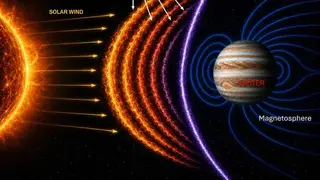
New Juno observations show Jupiter's bow shock differs from Earth's, using a broader spectrum of plasma waves and smaller shock structures to slow the solar wind. This behavior helps heat and deflect incoming particles before they reach the planet's magnetosphere. The findings, led by the University of Iowa, offer a nearby example of shock physics relevant to more energetic cosmic environments.
Juno's measurements reveal that Jupiter's bow shock operates across a wider range of plasma wave frequencies than Earth's, with these "harmonic" structures capable of transferring energy to a broader population of solar wind particles. The spacecraft also detected discrete shocklet regions that progressively decelerate incoming particles before they encounter the planet's main bow shock boundary.
These observations stem from Juno's ongoing mission, which has studied Jupiter since its 2011 launch. The findings provide a comparative framework for understanding shock physics in more extreme cosmic settings, such as supernova remnants, where similar wave-particle interactions may accelerate particles to extraordinary energies.
This research could deepen understanding of how planetary magnetic shields deflect harmful solar radiation, potentially informing future spacecraft design and astronaut safety protocols for deep-space missions. The comparative shock physics may also refine models of high-energy astrophysical phenomena, which could improve predictions of cosmic ray behavior affecting satellite electronics and power grids on Earth. However, direct societal applications remain distant, as this is foundational science that builds knowledge incrementally.