Understanding the Growing Power of Tropical Cyclones
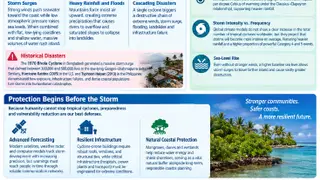
Tropical cyclones form over warm ocean waters and intensify through a feedback loop of evaporation, condensation, and latent heat release, with the Coriolis effect providing their spin. While wind speeds define their category, water-related hazards such as storm surges and flooding often cause the greatest destruction. As climate warming alters the conditions that drive these storms, coastal communities worldwide face an increasing threat.
Tropical cyclones function as vast heat engines, requiring sea surface temperatures near 26.5°C to form. The process relies on a self-reinforcing loop: evaporation feeds moisture into rising air, condensation releases latent heat, and the resulting warmth lowers central pressure, drawing in more humid air. The Coriolis effect supplies the spin, which is why these systems rarely develop within roughly five degrees of the Equator.
While wind categories—from Category 1 at 119 km/h to Category 5 at 252 km/h—dominate public perception, water hazards historically cause the worst destruction. Storm surges, rainfall-induced flooding, and landslides account for most fatalities, as seen in the 1970 Bhola Cyclone and Typhoon Haiyan. Climate projections indicate fewer overall storms but a greater share of intense Category 4 and 5 events, with heavier precipitation and amplified surge reach due to rising sea levels.
Coastal communities across the Asia-Pacific region could face heightened exposure as warmer oceans and rising sea levels amplify cyclone impacts. Dense populations in low-lying deltas and poorly protected coastlines may experience more severe flooding and infrastructure failure, straining emergency response systems. The shift toward fewer but stronger storms could make disaster planning more difficult, as communities must prepare for increasingly extreme rainfall and surge events rather than relying on historical patterns.