Magnetic fields in ancient meteorite grains shaped early solar system
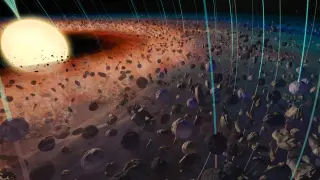
Analysis of calcium-aluminum-rich inclusions from an Antarctic meteorite shows a strong magnetic field existed within the first 200,000 years of solar system formation. The field, stronger than Earth's current one, may have helped pull material inward during the collapse of the solar nebula. This suggests magnetism worked alongside gravity in building the sun and planets.
The Antarctic meteorite's calcium-aluminum-rich inclusions represent the earliest solid material from the solar nebula, preserving magnetic signatures from roughly 4.6 billion years ago. Researchers estimate the ancient field exceeded Earth's current magnetic strength, suggesting substantial electromagnetic activity during the nebula's collapse phase. This finding extends earlier MIT work that documented magnetism at the two-million-year mark, when planet formation was already underway.
The proposed mechanism involves charged particles within the collapsing cloud generating plasma, which circulated through the developing disk and sustained a magnetic field. That field could have channeled material toward the forming sun, complementing gravitational pull. The research, published in the Proceedings of the National Academy of Sciences, involved collaboration across MIT, Tsinghua University, Cambridge, Caltech, and UCLA.
This discovery could reshape how scientists model planetary formation, potentially influencing future research funding priorities and educational curricula in astrophysics. Understanding magnetism's role may aid efforts to identify habitable exoplanets by refining models of how solar systems develop. The findings could also inspire public interest in space science, though practical applications remain distant. Researchers and students in planetary science may see new avenues for investigation, while the broader public gains a more complete picture of Earth's cosmic origins.