Huawei Unveils UnifiedBus Architecture to Boost AI Cluster Performance
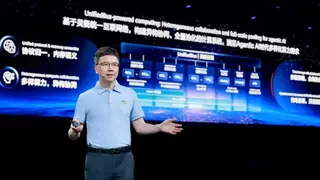
Huawei introduced its UnifiedBus interconnect architecture at HUAWEI CONNECT 2026, designed to address performance bottlenecks in large-scale AI clusters. The architecture combines multiple protocols to increase bandwidth and reduce latency, improving resource utilization for training and agentic applications. It supports collaboration between clusters and SuperPoDs.
The UnifiedBus architecture consolidates over ten interconnect protocols into a single standard, lifting bandwidth from the 100 GB/s range to the terabyte-per-second level while cutting round-trip latency from 7 to 2 microseconds. This unified protocol also enables global memory addressing across SuperPoDs, allowing NPUs, CPUs, memory, and SSDs to communicate directly in a peer-to-peer fashion. Huawei claims this design supports flexible CPU-NPU mixing and tiered hardware acceleration for Transformer models, including Attention-FFN disaggregation. The architecture also introduces hybrid-media resource pooling, using DDR memory as an alternative to NPU HBM, which reportedly doubles vector retrieval performance for billion-scale data sets and reduces HBM requirements for training trillion-parameter models. New interconnect products span cabinet, inter-cabinet, and cross-cluster levels, with the LinkBlade eliminating cable losses and cutting copper cabling by roughly 196 kilometers within a 4,096-NPU SuperPoD.
This architecture could reshape how large-scale AI clusters are deployed, potentially lowering the cost and energy waste of training massive models. Enterprises and cloud providers may benefit from higher utilization rates—currently as low as 20% in 100,000-NPU clusters—leading to faster development of agentic applications. However, reliance on proprietary interconnect standards could deepen vendor lock-in for customers, while the reduced need for high-bandwidth memory might shift supply chains. Society may see more capable AI services, but also increased concentration of compute power among a few tech giants.