Mars Express reveals purple and pink terrain near Martian south pole
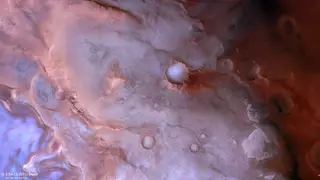
A new image from ESA's Mars Express orbiter shows the Thyles Rupes ridge near Mars' south pole in unusual purple and pink hues. The colors result from morning light, atmospheric dust, and patches of ice and frost. The image was released on September 16, 2026.
The image reveals how varied Mars' surface composition truly is. Dark patches indicate volcanic minerals like olivine and pyroxene, materials also found in Earth's mantle, while lighter regions show carbon dioxide frost. The glacier visible at lower left belongs to the planet's south polar ice cap, and rippled sand dunes at lower right echo similar formations seen in satellite views of Earth.
Thyles Rupes itself formed billions of years ago when Mars' interior cooled and contracted, pushing crust upward into cliffs exceeding one kilometer in height. The craters intersecting these ridges tell a geological story—some predate the cliffs, others cut through them afterward. Since Mars lacks active plate tectonics today, these features preserve a frozen record of the planet's ancient past.
This striking image may help the public see Mars as a dynamic, varied world rather than a static red dot, potentially boosting interest in planetary science and future exploration missions. Educators and science communicators could use such visuals to engage younger audiences in geology and astronomy. The aesthetic appeal of the purple terrain may also spread widely on social media, fostering broader public appreciation for space research and the value of continued orbital observation of other planets.