OceanX’s Unusual Floating Wind Design Gains Credibility After Typhoon Test
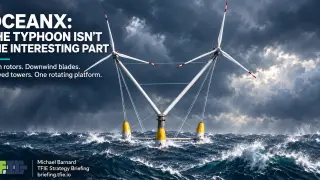
OceanX is a floating wind platform with two turbines mounted downwind of their supports. During Super Typhoon Yagi, it recorded strong winds and large waves while showing only small nacelle inclination and responses matching pre-storm simulations. The author now considers the design worth examining, though the storm did not prove it is economic or optimally engineered.
OceanX is a floating platform carrying two turbines whose rotors sit behind their supports. During Super Typhoon Yagi, instruments recorded wind above 41.5 m/s at the nacelle, waves with a significant height of 6.5 m and a maximum of 9.8 m. Nacelle tilt varied only about 0–3 degrees, and platform behavior matched pre-storm modeling without clear abnormal resonance or lasting attitude shift.
Historically, downwind turbines suffered because blades repeatedly crossed disturbed air behind a tower, adding fatigue and rhythmic noise. OceanX instead uses slender inclined supports tensioned by stays, which may create a narrower wake. The whole platform can also rotate with wind direction around its moorings, keeping rotors, supports and stays aligned rather than relying on two separate nacelle steering systems.
If validated further, designs like OceanX could inform floating wind projects in storm-exposed waters, potentially affecting developers, insurers, grid planners, and coastal communities through changed cost, reliability, and siting assumptions. It may also shape research priorities around downwind rotors and shared floating platforms. However, the test did not establish economics or optimal engineering, so societal effects remain uncertain and likely gradual.