US Risks Losing Clean Tech Race to China, Op-Ed Warns
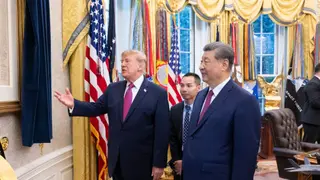
An op-ed argues that the US and China are pursuing opposite energy strategies, with Washington reversing clean energy policies while Beijing centralizes industrial policy to dominate supply chains. The recent White House summit between Presidents Trump and Xi focused on trade, critical minerals, AI, and security, leaving climate and energy cooperation largely aside. The author warns this gap could reshape economic power in solar, onshore wind, offshore wind, and geothermal sectors.
The op-ed contrasts the Xi-Trump White House meeting, where trade, critical minerals, AI, and security dominated, with the absence of climate and energy cooperation. It says Beijing is centralizing industrial policy while Washington reverses clean energy policies, widening gaps in investment, technology, and manufacturing.
China’s 2026–2030 renewable plan reportedly sets binding wind and solar capacity goals, including 370 GW of solar across desert and Gobi mega-bases and advanced storage. U.S. tax credit cancellations, IRA grant rescissions, and tariffs are described as delaying domestic manufacturing and cost parity. Onshore wind in China is tied to UHV transmission and an 11% capacity credit standard.
If the described divergence continues, workers and manufacturers in solar, wind, and geothermal supply chains could face shifting investment and job prospects. Consumers may see different energy prices and technology availability depending on policy. Trade and mineral dependencies may influence national security and industrial resilience. The summit’s focus on competition over climate cooperation may shape how quickly cleaner energy technologies spread, with consequences for communities reliant on changing energy sectors.