Webb captures vast star nursery IC 348 in record-sized panorama
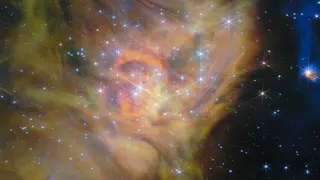
The James Webb Space Telescope has released a large near-infrared view of IC 348, a star-forming reflection nebula about 1,000 light-years away in Perseus. The panorama shows young stars, protostellar jets, and brown dwarfs with masses only around twice that of Jupiter. It is one of Webb's largest images to date and was shared on Sept. 15, 2026.
IC 348 is a reflection nebula and one of the closest star-forming regions, about 1,000 light-years away in Perseus. Webb’s near-infrared panorama captures young stars, jets from still-forming protostars, and dusty clouds across a wide field.
Researchers used NIRCam in 2024 to identify 39 brown dwarf candidates, then NIRSpec in 2025 to examine 15. Nine proved to be new substellar cluster members; the faintest may be about twice Jupiter’s mass. Their cores stay too cool to ignite hydrogen fusion, so they are not true stars.
The release could boost public interest in astronomy and space science, particularly among students and casual observers attracted by Webb’s imagery. Astronomers may gain wider attention and data access, while educators could use the panorama to explain star formation and brown dwarf limits. Its main effects may be cultural and scientific rather than immediate, though it could help sustain interest in long-term space observatories.