Ancient fossils link oxygen to early complex life
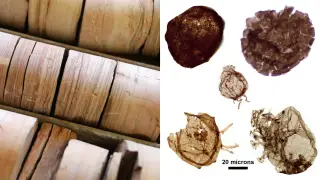
More than 12,000 fossils from ancient Australian rocks show some of the oldest known eukaryotes, dating back about 1.7 billion years. These complex cells appeared in habitats from coastal mudflats to open ocean, but only where oxygen was present; anoxic settings held simpler microbes. The pattern supports the view that oxygen availability was important for the emergence of complex life.
The fossils come from rock cores stored in Darwin, Australia. They were drilled decades ago by mining companies and later recognized as mudstone from an old inland sea. More than 12,000 specimens preserve single-celled eukaryotes, some about 1.75 billion years old.
Eukaryotes differ from prokaryotes by having nuclei and specialized internal structures. Their lineage likely began when an archaeon and a bacterium merged. Modern eukaryotes mostly rely on oxygen for energy, though some unusual examples survive without it, complicating the picture.
The findings could influence how scientists, educators, and museums explain the rise of complex life, potentially refining textbook narratives about oxygen and evolution. They may also inform astrobiology by suggesting that oxygen availability matters when assessing whether other worlds could host complex organisms. For the public, the story offers a concrete example of how drill-core archives and microscopic fossils can reshape understanding of life’s deep history.