Locating the Faint Constellation Equuleus in Autumn Skies
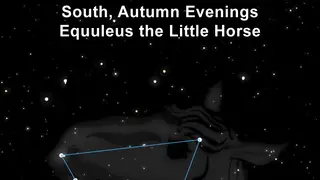
Equuleus, the second smallest constellation in the night sky, becomes visible during autumn months and is best found by locating the nearby Great Square of Pegasus and Summer Triangle. According to mythology, this diminutive star pattern represents the offspring of Pegasus the Winged Horse, though some accounts identify it with a sea horse created by Neptune. Observers with dark skies can use nearby bright asterisms as reference points to identify this challenging but rewarding target.
Equuleus presents a significant observational challenge for amateur astronomers due to its diminutive size and faint stellar components. At less than 13 degrees across at its widest point, it ranks as the smallest constellation visible from the Northern Hemisphere. The constellation's brightest star, Alpha Equulei or Kitalpha, reaches only magnitude 3.92—requiring reasonably dark skies for reliable identification. This extreme faintness means casual stargazers will struggle without nearby reference points like Pegasus or the Summer Triangle to guide their search.
The constellation's sparse deep-sky inventory further limits its appeal to telescope observers. Lacking any Messier catalog objects and containing only faint galaxies unsuitable for amateur equipment, Equuleus offers little for serious deep-sky study. NGC 7040, the constellation's most notable galaxy, remains barely visible at magnitude 15, demanding substantial aperture and ideal observing conditions. Consequently, Equuleus attracts primarily dedicated hobbyists seeking to complete constellation catalogs rather than those pursuing spectacular celestial phenomena.
This article may reinforce public interest in observational astronomy and promote nighttime outdoor recreation. By highlighting accessible stargazing targets tied to seasonal changes, such coverage could encourage amateur astronomers to develop stronger dark-sky awareness and advocate for light pollution reduction. Educational value emerges through increased understanding of classical mythology's connection to modern astronomy. The story's emphasis on challenge-based observation may appeal selectively to dedicated enthusiasts rather than broaden general scientific engagement significantly.