Chinese Rocket Stage Exhibits Unexplained Orbital Maneuver Despite Non-Maneuvering Classification
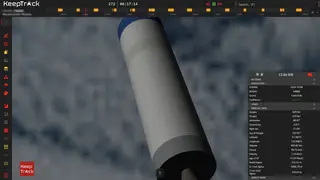
An automated detection system flagged a significant orbit anomaly on a Chinese CZ-8A rocket stage that lacks known propulsion capability, showing a mean motion change of -0.04649 revolutions per day detected between September 22-23, 2026. The anomaly produced an estimated total delta-V of 1.83 meters per second, creating peak positional offsets exceeding 10,000 kilometers with semi-major axis changes of approximately 2 kilometers. The event remains unconfirmed pending analyst review and subsequent orbital element validation, raising questions about either undisclosed maneuver capabilities or external perturbation factors affecting the debris object.
The detection system identified a substantial orbital shift in the Chinese rocket stage between September 22-23, 2026, with the object's mean motion decreasing by approximately 0.04649 revolutions per day. This change proved statistically significant—roughly 930 times larger than the typical measurement uncertainty for such observations. The shift resulted in the rocket body moving to a lower orbital configuration, with its semi-major axis shrinking by nearly 2 kilometers and creating maximum separation distances exceeding 10,000 kilometers from its predicted trajectory.
The anomaly presents an interpretive puzzle for space operations analysts. Either the rocket stage possesses undisclosed propulsive systems capable of executing the observed 1.83 meter-per-second maneuver, or alternative explanations such as unmodeled atmospheric drag, solar radiation pressure, or gravitational perturbations account for the orbital change. Confirmation requires analysis of subsequent orbital measurements to determine whether the object maintains its new trajectory or returns to pre-event parameters, with results expected within days of the initial detection.
This event could have relevance for space situational awareness and debris tracking operations, which monitor thousands of inactive rocket stages to prevent collisions with active satellites and spacecraft. If confirmed, the anomaly might prompt reviews of cataloging procedures for Chinese launch vehicles or raise questions about debris object characterization. The incident may also engage international space operations communities in discussions about transparency regarding orbital maneuver capabilities and the technical adequacy of existing tracking systems.