University of Alberta Develops Improved Method for Measuring Quasar Pair Distances
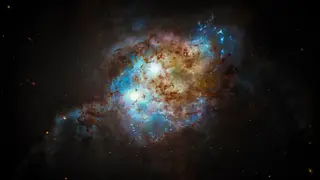
Researchers at the University of Alberta have created a more accurate technique for measuring distances between paired quasars, addressing a longstanding challenge in determining cosmic expansion rates. The new method reduces errors that previously reached up to 10 million light-years by accounting for the difficulty of measuring line-of-sight separation in three-dimensional space when observing these distant objects. This advancement should improve the precision of measurements used to study how the universe expands over time.
Quasars are among the universe's most luminous objects, powered by supermassive black holes that funnel material into rapidly spinning accretion disks. When two galaxies containing quasars begin merging, their central black holes eventually combine, creating even larger gravitational engines. The challenge for astronomers has been accurately determining how far apart these paired quasars are along the observer's line of sight—essentially gauging depth in three-dimensional space from a two-dimensional celestial image.
The University of Alberta team's breakthrough applies the Quasar Proximity Effect, which analyzes how a quasar's intense radiation ionizes and heats nearby hydrogen gas. By studying the resulting transparent regions in spectroscopic data, researchers can infer the spatial separation between two quasars with substantially greater precision than traditional velocity measurements allow, reducing uncertainty from tens of millions of light-years to approximately half a million.
This methodological refinement could enhance astronomers' ability to map cosmic expansion more accurately, potentially improving estimates of fundamental constants governing universe evolution. Enhanced distance measurements may also clarify merger timescales between distant galaxy pairs, offering insights into how supermassive black holes grow and interact. While the immediate impact remains confined to the scientific community, more precise cosmological measurements could eventually inform theoretical models underlying our understanding of dark energy and universal structure formation.