Researchers Detect Anomalous Polarization Patterns in Ancient Cosmic Radiation
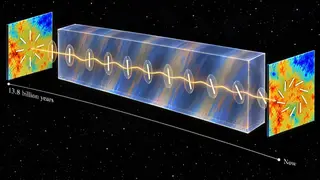
Scientists have conducted a new analysis of the cosmic microwave background's polarization patterns, finding evidence that contradicts predictions from the standard cosmology model which assumes a uniform universe. The study reveals a rotation of E-mode polarized light into B-mode patterns, a phenomenon called cosmic birefringence, suggesting the universe may not be as homogeneous as previously thought. This finding aligns with an earlier study and indicates subtle physical processes occurring in the ancient light that has traveled billions of years to reach Earth.
The cosmic microwave background represents the oldest observable light in the universe, released roughly 380,000 years after the Big Bang when matter cooled sufficiently for photons to travel freely. Scientists analyze this ancient radiation's polarization characteristics—the orientation of its light waves—to understand fundamental cosmic properties. Two distinct polarization patterns exist: E-modes, which appear to radiate outward from points, and B-modes, which shift relative to neighboring regions. While E-modes arise from temperature variations and have been well-documented since 2002, B-modes can originate from multiple sources including gravitational lensing or primordial gravitational waves.
The new research addresses a fundamental challenge in cosmological observation: distinguishing genuine cosmic phenomena from measurement artifacts. By examining multiple independent datasets from the Planck spacecraft and comparing their statistical properties, researchers could test whether observed polarization shifts represent true cosmic properties rather than instrumental or analytical biases. This methodological approach strengthens confidence in previous findings suggesting the universe may deviate from predicted uniformity.
If confirmed through additional observations, evidence of cosmic birefringence could reshape fundamental physics understanding and require revisions to standard cosmological models that currently underpin our knowledge of the universe's structure and history. Such findings could influence theoretical research directions across physics departments and funding priorities for next-generation space telescopes. For the general public, confirmation may eventually affect how scientists explain cosmic origins, though practical applications would likely remain distant. The research primarily impacts the scientific community's immediate research agenda and theoretical frameworks.