ALMA Telescope Detects Pristine Neutral Gas in Galaxies from Universe's First Billion Years
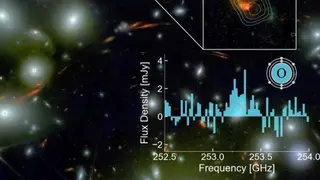
An international research team used the ALMA telescope to identify neutral gas in four galaxies formed approximately 700 to 800 million years after the Big Bang, providing direct evidence of star-forming material in the early universe. The detection was accomplished through specialized spectroscopy techniques measuring emission lines from neutral oxygen atoms, bypassing the inability of optical telescopes to observe this type of gas. These findings offer important insights into the conditions and mechanisms that allowed the universe's first stars and galaxies to form during the cosmic dawn.
The research team employed a specialized detection method unavailable to optical and infrared observatories. Because neutral gas lacks the radiation signatures that traditional space telescopes capture, ground-based millimeter-wavelength instruments became essential. The astronomers identified their target galaxies by analyzing specific electromagnetic emissions produced by oxygen atoms, then cross-referenced these findings with complementary data to rule out alternative explanations.
The four observed galaxies demonstrated a striking structural difference from modern equivalents. Rather than the dispersed stellar distributions seen in today's universe, these ancient systems showed remarkably compact arrangements where stars formed in close proximity. This density variation provides measurable evidence about how star formation processes and galactic structures evolved across cosmic history.
These findings could influence theoretical models of early galaxy development and inform future observational priorities in cosmology. Scientists and educators may use these results to refine understanding of fundamental cosmic processes, potentially affecting how space agencies allocate resources for telescopes and observational campaigns. The research demonstrates how complementary instruments—ground and space-based—strengthen astronomical discovery, suggesting that collaborative observational approaches may yield broader insights into humanity's place in an evolving universe.