Quadruped Robot Completes Full Marathon on Single Battery Charge
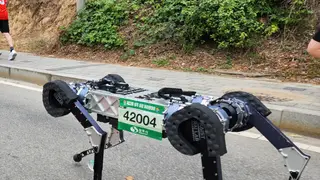
A South Korean research team developed RAIBO2, a four-legged robot that completed a full marathon in approximately four hours and nineteen minutes while using only 66 percent of its battery capacity. The robot achieved this feat through a holistic optimization approach that reduced energy losses across joints and circuits while improving AI-based gait control. This breakthrough demonstrates the potential for legged robots to operate over distances exceeding 40 miles, roughly triple the range of current designs.
South Korean researchers at KAIST tackled the energy efficiency problem by taking a comprehensive approach rather than improving individual components in isolation. They systematically mapped where power was being wasted throughout the robot's mechanical joints and electrical systems, then redesigned these areas in concert with one another. This integrated strategy, combined with enhanced artificial intelligence for movement control, allowed RAIBO2 to maintain better footing and stability at higher speeds.
The robot's previous attempt at the same marathon distance fell short by several miles when its battery depleted prematurely. Investigators discovered that frequent speed adjustments during that run had accelerated power consumption beyond predictions. The team applied lessons from human endurance athletics, recognizing that optimizing the entire system's interaction—rather than isolated parts—was essential to achieving sustained long-distance operation.
If quadruped robots can reliably operate over 40-mile ranges on single charges, they may become more practical for search-and-rescue missions, industrial inspections, and emergency response in areas where wheeled vehicles cannot traverse. Extended endurance could expand deployment possibilities in remote or hazardous environments where frequent battery replacement or charging infrastructure is unavailable. However, real-world application would depend on whether these efficiency gains transfer from controlled marathon conditions to unpredictable field scenarios with varying terrain and weather.