Government Competition Aims to Deliver First Fault-Tolerant Quantum Computer Within Two Years
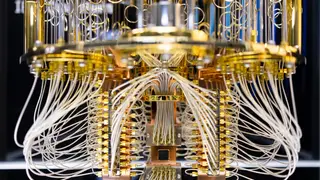
The U.S. Department of Energy announced a $215 million competition called Quantum Genesis Q, challenging private companies to develop a fault-tolerant quantum computer with at least 100 logical qubits capable of solving real scientific problems by 2028. Current quantum machines remain limited by error-prone qubits that restrict their practical applications to theoretical problems. The initiative provides companies with financial incentives and a roadmap to accelerate development of quantum systems that could advance research in chemistry, materials science, and other fields.
The Department of Energy's initiative addresses a fundamental barrier that has limited quantum computing to theoretical exercises: the inherent fragility of qubits. These quantum bits degrade rapidly during calculations, necessitating error-correction systems that distribute information across multiple physical qubits to create reliable "logical qubits." This approach demands significantly larger machines than currently exist, making the leap to 100 logical qubits a substantial engineering challenge.
The competition structure provides tiered incentives to accelerate progress. Early-phase participants can secure up to $1.5 million for reaching unspecified milestones, while the bulk of funding—distributed across $100 million, $50 million, and $50 million pools—rewards teams that successfully build and validate fault-tolerant systems. The Department of Energy plans to support between 3 and 10 organizations and has allocated an additional $45 million for national laboratory testbeds to verify competing systems' performance.
Achievement of fault-tolerant quantum computers could reshape research in chemistry, drug discovery, and materials design by enabling calculations impossible for classical supercomputers. However, the technology's impact hinges on whether competing teams can meet aggressive timelines and deliver genuinely useful results. Success may accelerate innovation in multiple scientific fields, while delays could affect competitiveness in quantum technology development. The outcome may influence future funding priorities and public-private research partnerships.