Telecom Operators Maximize Revenue Per User Through Premium Plans and Customer Convergence Strategies
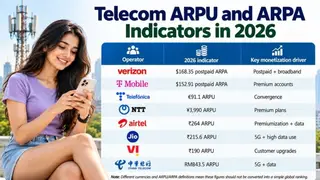
Major telecom operators are achieving substantially different average revenue per user metrics in 2026, with Verizon reporting postpaid ARPA of $168.35 and T-Mobile at $152.91, while European and Asian operators employ varying monetization approaches based on market maturity and customer mix. High data consumption alone does not guarantee premium pricing, as demonstrated by the diverse ARPU figures across Verizon, Telefónica, Airtel, Jio, and other carriers using different measurement definitions and currencies. Operators increasingly focus on postpaid customer mix, convergence between wireless and broadband services, and loyalty programs to drive revenue growth as subscriber acquisition becomes more challenging in saturated markets.
The telecommunications industry's shift toward revenue optimization reflects fundamental market maturation. In developed regions like North America and Europe, operators face saturated subscriber bases where growth through new customer acquisition has slowed considerably. This reality has prompted a strategic pivot toward extracting greater value from existing relationships through bundled services—combining wireless, broadband, and television offerings into single household packages. Operators increasingly recognize that a customer subscribing to multiple services generates substantially higher lifetime value than a mobile-only user, regardless of data consumption patterns.
The divergence in metrics across regions underscores how market conditions shape pricing strategies. American and European carriers emphasize postpaid accounts with premium tiers and service convergence, while operators in developing markets like India continue building scale in prepaid segments where single-service ARPU remains the dominant measurement. This fragmentation means direct global comparisons are misleading; each operator optimizes for its specific market structure, competitive position, and customer demographics rather than pursuing identical monetization approaches.
These revenue strategies could influence consumer choice and affordability across different markets. Bundled service approaches may benefit households with multiple connectivity needs through convenience and potential discounts, though they could also reduce competition by encouraging lock-in effects. In developing markets, prepaid-focused models sustain access for price-sensitive populations but may limit premium service availability. Regulators may examine convergence strategies to assess competitive impacts, while consumers could experience varying pricing pressure depending on their geography and ability to adopt bundled offerings.