Russia's Military Support Deepens Entanglement with West African Authoritarian Regimes
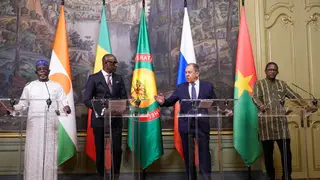
Russia's paramilitary Africa Corps has become increasingly embedded in Sahel politics, recently helping Niger's military junta suppress a coup attempt and supporting Mali's government against jihadist attacks. The intervention exemplifies Russia's strategy of using counterterrorism operations to maintain influence over authoritarian client states across Africa. However, such deep military involvement with unpopular regimes risks regional instability and backlash from populations wary of foreign occupation.
Russia's Africa Corps, the successor organization to the defunct Wagner Group, has significantly expanded its footprint across the Sahel region by positioning itself as a counterterrorism partner to military governments. The organization's intervention during Niger's August 2026 mutiny represents an escalation beyond traditional security partnerships—marking the first instance where the paramilitary force directly defended a regime against internal armed opposition rather than external threats.
The broader geopolitical backdrop involves the rapid collapse of Western military influence in West Africa following a series of military coups between 2020 and 2023. As populations in former French colonies grew resentful of perceived neo-colonial oversight, newly empowered military juntas systematically dismantled defense agreements with France and the United States, creating a strategic vacuum that Russia has actively filled with security guarantees and military support.
Russia's deepening military entrenchment in the Sahel may reshape regional stability and Western strategic interests. Populations in affected countries could face prolonged military rule strengthened by external patronage, potentially delaying democratic transitions. Conversely, the model carries inherent risks for Russia itself—counterterrorism campaigns in the region have historically proven difficult for external actors to control, which may ultimately undermine Moscow's credibility if security situations deteriorate. The shift could also create openings for Western powers to rebuild influence through alternative means.