Particle collider reveals unexpected signals from recreated early universe matter
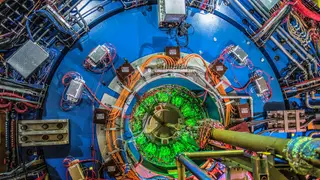
Researchers at the Relativistic Heavy Ion Collider at Brookhaven National Laboratory have detected an unexpected signal while analyzing collisions of gold ions that briefly recreated the quark-gluon plasma that filled the early universe. The findings offer new insights into the phase transition that occurred moments after the Big Bang, when the universe cooled enough for quarks and gluons to combine into protons and neutrons. This discovery provides experimental clues about the fundamental conditions and thresholds of one of the universe's most profound transformations.
The Relativistic Heavy Ion Collider at Brookhaven National Laboratory conducts experiments by accelerating gold ions to near-light speeds and observing their collisions. These violent interactions momentarily recreate conditions that existed fractions of a second after the Big Bang, when matter existed as a fluid mixture of fundamental particles rather than stable atoms. By measuring how the resulting particles scatter and move through space, researchers gather clues about the universe's earliest moments and the dramatic transformation that allowed matter to take its modern form.
The research team focused on transverse momentum fluctuations—variations in particle movement perpendicular to the collision direction. Their unexpected finding of a dip in these fluctuations suggests a phase transition occurs at extreme densities. This critical point, if confirmed through further study, would reveal precisely how and when fundamental forces reorganized primordial matter into the building blocks of all visible structures today.
This discovery may deepen humanity's understanding of fundamental physics and the universe's origins, primarily benefiting the scientific community through refined theoretical models. The findings could also have practical implications for astrophysics, potentially helping researchers better understand neutron stars and the extreme physics governing stellar collapse. While the immediate applications remain theoretical, improved comprehension of matter at extreme densities might eventually inform technologies or address longstanding questions about cosmic phenomena that shape our understanding of reality itself.