Understanding Global Landslide Risks Across Mountainous Regions and Human-Affected Areas
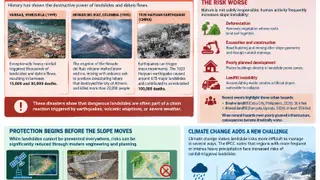
Landslides and debris flows pose the greatest threats in steep mountainous regions experiencing heavy rainfall, including the Himalayas, Andes, and Pacific Ring of Fire zones. Historical catastrophes such as the 1999 Venezuela disaster and 1985 Colombian volcanic lahars demonstrate the deadly potential when natural geological forces combine with weather or seismic activity. Human activities including deforestation, construction, and poor urban planning significantly amplify slope instability and disaster risk.
Landslide hazards emerge from the interaction of multiple physical factors rather than any single characteristic. While mountainous terrain with steep angles represents an obvious risk zone, the actual danger depends on rock composition, soil properties, moisture levels, and vegetation coverage. The Himalayas, Andes, and Pacific Ring of Fire regions face particularly high exposure due to both geological conditions and climatic patterns that combine to trigger slope failures. Secondary disasters can amplify impacts significantly—volcanic eruptions may generate lahars, earthquakes can destabilize entire hillsides, and heavy precipitation mobilizes already-weakened material into destructive flows.
Human development substantially increases these natural vulnerabilities. Deforestation removes stabilizing root systems, while excavation for roads and mining operations alter slope geometry and disrupt water drainage patterns. Recent catastrophic landfill collapses in the Philippines and Uganda demonstrate how inadequate infrastructure planning transforms heavy rainfall into mass casualty events when combined with poor site selection and maintenance practices.
Approximately 760 million people live in mountainous regions globally, and this population faces mounting exposure to landslide hazards. The convergence of natural geological risks with climate intensification and unplanned urbanization could substantially increase disaster frequency and severity in Asia-Pacific nations and other high-risk zones. Communities relying on early-warning systems, improved drainage infrastructure, and restrictive land-use policies may experience reduced casualties, while regions lacking such measures may face escalating humanitarian crises during heavy rainfall events.