NASA's Venus Probe Passes Extreme Heat Test in Preparation for Mission
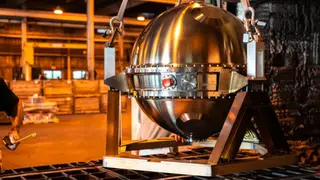
NASA's DAVINCI mission successfully completed thermal testing of its descent probe, subjecting it to temperatures of 869 degrees Fahrenheit to simulate the conditions it will experience during entry into Venus's atmosphere. The engineering unit passed six thermal cycles while maintaining internal instrumentation, demonstrating it can withstand the 55-60 minute descent to the Venusian surface. The probe will measure atmospheric composition, temperature, pressure, and winds while a separate spacecraft conducts cloud and surface observations from above.
NASA's DAVINCI mission represents a significant engineering achievement in planetary exploration. The descent probe underwent rigorous testing at a Pennsylvania facility, where it endured six consecutive heating cycles reaching 465 degrees Celsius—matching the actual temperature progression the craft will experience during its 55-60 minute plunge through Venus's atmosphere. The successful completion of these trials confirmed that the probe's titanium shell and internal sensors can withstand the planet's extreme conditions while maintaining operational capability.
The mission itself addresses fundamental questions about Venus's atmospheric evolution and surface composition. Scheduled for launch in the early 2030s, DAVINCI combines two complementary observation platforms: the descending probe will collect atmospheric chemistry and pressure data while imaging the Alpha Regio mountainous terrain below the cloud layer, while an orbital spacecraft simultaneously maps clouds and surface features from approximately 9,000 kilometers above. This dual approach aims to fill observational gaps left by decades of previous Venus missions.
DAVINCI could advance scientific understanding of planetary atmospheres and climate evolution, potentially offering insights into how planetary conditions diverge dramatically despite similar origins. The mission may generate new data about Venus's geological history and atmospheric composition that could inform broader theories about planetary habitability. Success could also demonstrate technological capabilities for future missions to other extreme environments, though the results primarily serve the scientific community rather than providing immediate practical applications for the general public.