Retreating Glaciers Destabilize Mountains, Unleashing Massive Fjord Tsunamis
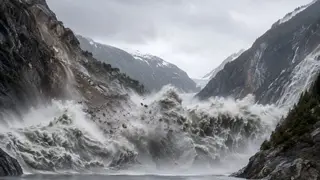
A catastrophic landslide in Alaska's Tracy Arm in August 2025 generated a tsunami wave that reached 1,580 feet up the opposite fjord wall, the second-highest tsunami ever recorded. Researchers found that the collapse occurred where a glacier had recently retreated, suggesting a pattern linking ice loss to mountain instability across the Arctic. This phenomenon is occurring from Alaska to Greenland and Norway, creating a growing hazard for coastal communities and vessels as climate change accelerates glacier retreat.
The August 2025 incident in Alaska's Tracy Arm occurred when a mountain adjacent to South Sawyer Glacier fractured and fell into the fjord, sending water and rock debris nearly a quarter-mile up the opposing valley wall. The timing was critical: the region had experienced rapid glacier shrinkage over the preceding weeks combined with significant rainfall, both factors that destabilize mountainsides in tectonically active Arctic regions.
Scientists identified a troubling correlation between glacier retreat and slope collapse occurring across multiple Arctic locations, from Alaska through Greenland to Norway. The mechanics explaining why ice loss triggers instability remain incompletely understood, though researchers suggest that when glaciers vanish, the mountains they previously supported lose structural reinforcement, making them vulnerable to failure during wet seasons.
This phenomenon could reshape maritime activity and coastal settlement patterns across the Arctic as climate-driven glacier loss accelerates. Cruise operators and fishing fleets may face restricted access to historically navigable waterways, potentially affecting tourism and local economies. Coastal communities in vulnerable regions could require comprehensive monitoring systems and evacuation protocols to mitigate risk, imposing significant infrastructure and operational costs on developing Arctic nations and territories already managing multiple climate adaptation challenges.