Telecom Giants Overhaul Networks to Support AI Workloads With Massive Fiber and Data Center Investments
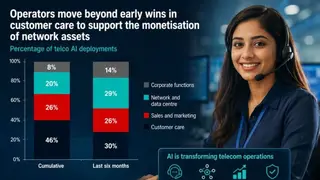
Telecommunications operators are restructuring their infrastructure investment strategies to accommodate artificial intelligence requirements, moving beyond traditional consumer broadband to support GPU clusters, distributed inference, and AI data centers. AT&T signed a $3 billion fiber supply deal with Corning while Verizon committed to over 80 million miles of high-density optical fiber through 2032, both agreements reflecting dual purposes of home broadband expansion and hyperscaler data center connectivity. Companies including SK Telecom, Airtel, and SoftBank are simultaneously expanding data center capacity and deploying specialized AI-optimized radio access networks.
The infrastructure pivot reflects a fundamental shift in how telecommunications companies allocate resources. Rather than treating computing as separate from network operations, operators now view data center capacity and fiber connectivity as integrated components of a unified system. China Mobile's projected spending increases exemplify this transformation—computing-network expenditures are rising at triple the rate of traditional telecom investments, signaling where major carriers see future revenue and competitive advantage.
The physical scale of these commitments underscores AI's infrastructure demands. Verizon's 80-million-mile fiber commitment and Lumen's expansion to 58 million intercity miles represent unprecedented investments in raw capacity. These fiber networks serve dual purposes: maintaining consumer broadband growth while simultaneously creating the high-capacity backbone required for AI data center clusters to communicate efficiently, a necessity driven by GPU workloads and distributed computing architectures that earlier networks were never designed to support.
These infrastructure investments could reshape competitive dynamics across technology and telecommunications sectors. Operators with capital to build extensive fiber networks and data center capacity may gain positioning advantages in serving cloud and AI companies, potentially affecting pricing and service availability for enterprise customers. Consumers could benefit from increased broadband capacity, though the extent depends on whether operators prioritize residential expansion or concentrate investment on hyperscaler connectivity. Regions with robust telecom infrastructure may attract more AI-related business investment, while underserved areas risk widening digital gaps.