Ancient granite sculpture in Sudan possibly depicts Kushite leadership
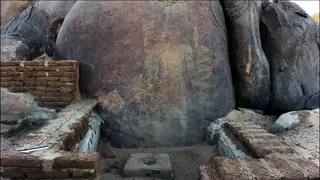
A life-size carved figure etched into a granite outcrop in Sudan's Mahas region has endured for thousands of years, with researchers hypothesizing it represents a Kushite ruler. The sculpture at Miseeda likely served as a territorial or political marker in the ancient kingdom. A Christian church was constructed near the site during the seventh century, indicating the carving's significance persisted across religious and cultural transitions.
The Miseeda carving represents a significant archaeological find in Sudan's Mahas region, where a monumental figure has been preserved within natural granite formations. Researchers interpret this life-size sculpture as a potential representation of leadership from the Kushite civilization, an ancient kingdom with substantial historical influence in northeastern Africa. Such carved figures likely functioned as public displays of authority and territorial control.
The site's enduring importance is underscored by later religious development. When Christian communities established a church nearby during the seventh century, they chose a location already marked by this ancient monument, suggesting the area retained cultural or symbolic value across different historical periods and belief systems.
This discovery could enhance scholarly understanding of Kushite political structures and how ancient societies projected power through monumental art. The findings may contribute to broader archaeological knowledge about Sudan's pre-Islamic heritage and inform discussions about heritage preservation in the region. Such research may also influence how communities value and protect sites containing multiple layers of historical significance.