Exceptionally long X-ray burst offers new evidence that neutron star collisions produce magnetars
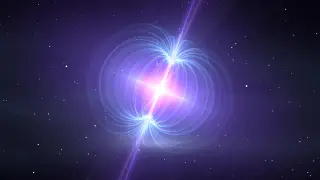
Researchers detected an X-ray flash lasting nearly 10 minutes from a distant galaxy, providing compelling evidence that some minutes-long X-ray transients originate from colliding neutron stars that form magnetars. The discovery may enable astronomers to identify these extreme cosmic merger events through a previously unrecognized signature distinct from the brief gamma-ray bursts typically associated with neutron star collisions.
Neutron stars represent the ultra-dense remnants left when massive stars exhaust their fuel and collapse. When two such objects orbit close enough to merge, the collision generates both gravitational waves and electromagnetic radiation across multiple wavelengths. Magnetars, a particular class of neutron stars distinguished by extraordinarily powerful magnetic fields, can amplify and extend the brightness of merger events by converting magnetic energy into radiation.
The detection capabilities of modern space-based observatories have improved significantly since the Einstein Probe satellite became operational in early 2024. This advancement enables researchers to capture detailed observations of transient cosmic events and conduct rapid follow-up studies using ground-based facilities, allowing astronomers to gather complementary data that helps identify the physical nature and distance of these mysterious phenomena.
This discovery could refine how astronomers catalog and understand neutron star mergers, potentially revealing previously overlooked cosmic events and improving predictions of where future mergers may occur. The work may ultimately enhance humanity's understanding of extreme physics and help validate theoretical models of matter under the universe's most severe conditions. Such insights could inform long-term strategies for gravitational wave detection networks seeking to capture these rare events.