Cornell University's Deployed Lightsails Demonstrate Critical Technology for Future Interstellar Travel
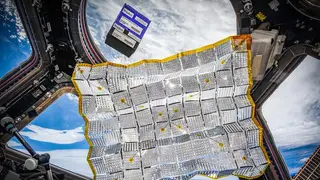
Engineering students at Cornell University successfully deployed two lightsail experiments—Alpha CubeSat and Sailing to the Stars—from the International Space Station, with results published demonstrating viable proof-of-concept for solar sail technology. The missions tested origami-style lightsails and small chip satellites that were folded for launch and deployed in space, including demonstrations of spin-stabilization algorithms, avionics systems, and novel tracking technologies. These experiments represent essential steps toward developing the laser-pushed sail systems required for potential interstellar exploration missions.
Solar sail technology represents a fundamentally different approach to space propulsion compared to conventional rocket engines. Rather than carrying fuel, these spacecraft rely on radiation pressure from focused laser beams to accelerate reflective surfaces to extreme velocities. The Cornell experiments employed miniaturized satellites small enough to fit in a pocket, demonstrating that even tiny craft can successfully deploy complex mechanisms and transmit data across vast distances.
The research builds on decades of theoretical work by adding crucial practical validation. By testing origami-style deployment mechanisms, stabilization systems, and communication protocols in actual orbital conditions, the Cornell team identified design solutions applicable to future missions. The use of 3D-printed components and consumer electronics like hard drive motors shows how educational programs can advance spaceflight capabilities through innovation rather than unlimited budgets.
These demonstrations could influence long-term space exploration strategy by validating technologies essential for reaching distant star systems. Success here may encourage greater institutional and private investment in lightsail research and directed-energy propulsion systems. For the aerospace industry and academic institutions, the results suggest that university-led projects can meaningfully contribute to next-generation propulsion development. Broader societal implications remain speculative but could eventually reshape humanity's capacity for deep-space exploration and scientific discovery beyond our solar system.