Distant Spiral Galaxy Shows Signs of Gravitational Interaction with Companion
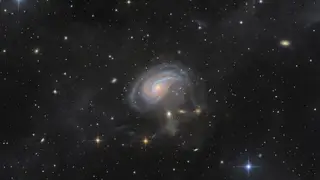
Astronomers have observed the peculiar spiral galaxy Arp 78, located approximately 100 million light-years away in the constellation Aries, which displays an unusually prominent outer spiral arm spanning about 200,000 light-years. The galaxy's distinctive structure is believed to result from gravitational interactions with its nearby companion galaxy NGC 770, which has stretched and amplified its spiral arms to exceptional proportions. Deep telescopic imaging reveals faint stellar streams and young blue star clusters distributed along the sweeping dust lanes of this cosmic interaction.
Arp 78, cataloged as NGC 772, represents a fascinating example of galactic dynamics in action. Located in the constellation Aries at a distance of 100 million light-years, this spiral galaxy spans approximately 200,000 light-years across—comparable to our own Milky Way. Its most striking feature is an unusually pronounced outer spiral arm that extends far beyond typical galactic proportions.
The galaxy's dramatic morphology stems from gravitational interactions with NGC 770, a smaller elliptical companion galaxy positioned nearby. The tidal forces generated by this cosmic proximity have stretched and enhanced Arp 78's spiral structure, creating the distinctive configuration visible in deep telescope observations. Young blue star clusters and faint stellar streams scattered throughout the dust lanes provide evidence of this ongoing gravitational dance between the two galaxies.
This observation contributes to broader scientific understanding of galactic evolution and merger processes that shape cosmic structures over billions of years. Such studies may enhance astronomers' ability to model galaxy interactions and predict long-term structural changes in galactic systems. While these distant phenomena pose no direct societal implications, improved knowledge of galactic dynamics could refine cosmological models that inform fundamental physics research and our comprehension of the universe's large-scale architecture.