JUICE Spacecraft Executes Precise Earth Gravity Assist, Gains Critical Velocity Toward Jupiter
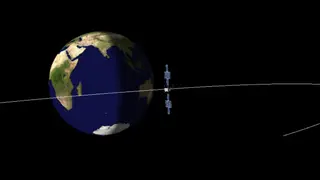
The European Space Agency's Jupiter Icy Moons Explorer performed a successful gravity-assist maneuver on September 28, 2026, approaching Earth at a distance of 8,640 kilometers above the Indian Ocean and increasing its velocity by 3.5 kilometers per second. The maneuver also adjusted JUICE's trajectory by 20 degrees, allowing the spacecraft to conserve fuel while modifying its course toward Jupiter with remarkable precision. The flyby, which included images of Earth and the Moon captured by onboard cameras, represents JUICE's third gravity-assist maneuver since its April 2023 launch, with one additional Earth flyby planned for January 2029 before the spacecraft reaches Jupiter in July 2031.
JUICE's September 2026 Earth encounter represents the third in a series of strategically planned gravitational interactions designed to redirect the spacecraft toward its destination with minimal fuel expenditure. Since launching in April 2023, the mission has leveraged celestial bodies—the Moon, Venus, and now Earth—to progressively adjust its velocity and course. The spacecraft's instruments seized this opportunity to conduct calibration tests on a familiar planetary body, gathering data on Earth's magnetosphere while capturing detailed imagery that will inform scientific operations during the mission's primary objective.
The January 2029 Earth flyby will serve as JUICE's final gravity assist before the spacecraft enters Jupiter's orbital neighborhood. Once there, the mission will conduct approximately 35 close approaches to Jupiter's icy moons, beginning with arrival in July 2031. These upcoming maneuvers represent significantly greater navigational complexity than the Earth flybys, requiring unprecedented precision as JUICE investigates these distant worlds.
JUICE's successful gravity-assist maneuver advances European space capabilities in deep-space navigation and could strengthen the ESA's scientific standing in planetary exploration. The mission's achievement may inspire continued investment in multi-year space initiatives while demonstrating technological competency relevant to future international space endeavors. Scientists and institutions globally could benefit from data JUICE gathers about Jupiter's moons, potentially reshaping understanding of habitability in distant solar systems. The mission's progression may influence resource allocation decisions for subsequent exploration missions.