European Aviation Authority Prolonging Middle East Airspace Advisory Amid Escalating US-Iran Conflict
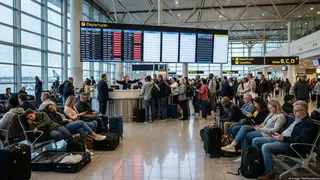
The European Union Aviation Safety Agency has extended its conflict-zone warnings for Persian Gulf and Gulf of Oman airspace through mid-November 2026 as military tensions between the United States and Iran remain elevated. The guidance advises airlines to avoid specified airspace over Bahrain, Kuwait, Qatar, the UAE, and parts of the Oman flight information region, though the advisory carries weight through industry practice rather than legal enforcement. Airlines face rerouting decisions that increase flight times and costs for passengers traveling between Europe, the Middle East, and Asia.
The European Union's conflict-zone bulletin system represents a coordinated approach to aviation risk management across the region. Rather than imposing legally binding flight bans, these advisories function as authoritative guidance that airlines treat as mandatory in their operational planning. The current warning reflects a narrower geographic scope than earlier 2026 advisories, suggesting regulators are attempting to balance safety concerns with the practical need to maintain some air connectivity through the Middle East.
Military incidents in the Gulf region—including air defense activity, missile launches, and drone operations—create unpredictable hazards beyond deliberate targeting. Regulators cite the risk of misidentification, debris from military intercepts, and rapid changes in tactical situations as primary concerns. The extension through November 2026 indicates European authorities see no near-term de-escalation that would justify removing these precautions.
The advisory affects airlines operating between Europe and Asia, potentially increasing journey times and fuel costs for passengers on transcontinental routes. Travelers connecting through major Gulf hubs like Dubai and Doha may experience flight delays or higher ticket prices as carriers reroute around restricted airspace. The economic impact extends to regional aviation industries dependent on transit traffic, while airlines face pressure to balance safety compliance with operational efficiency and competitiveness.