Ukraine and Japan Explore Expanded Defense Partnership During Kyiv Visit
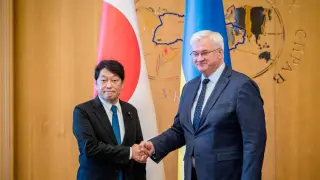
Ukrainian Foreign Minister Andrii Sybiha met with a delegation of Japanese lawmakers from the ruling Liberal Democratic Party in Kyiv to discuss strengthening bilateral security cooperation and addressing shared regional threats. The two nations examined Russia's military collaboration with North Korea and explored mechanisms for utilizing frozen Russian assets to support Ukraine. Both sides emphasized that security challenges in Europe and Asia are interconnected and require coordinated responses.
Japan has demonstrated substantial commitment to Ukraine's security since Russia's 2022 invasion, providing more than $20 billion in combined financial and humanitarian assistance. The nation has recently channeled funds through innovative mechanisms, including a $1.3 billion grant derived from seized Russian assets under international G7 coordination, and additional military financing contributions through NATO frameworks. This latest ministerial engagement represents the deepening of these ties into formal defense partnership discussions.
The meeting highlighted growing awareness among democratic nations that regional conflicts carry transnational implications. Both Ukraine and Japan face pressure from Russian military expansion and North Korea's involvement, prompting them to coordinate on sanctions enforcement and asset seizure strategies. The focus on Black Sea shipping restrictions underscores how regional security disruptions affect global economic stability and food security beyond the immediate conflict zone.
This partnership development could strengthen Ukraine's military-diplomatic position while signaling to Beijing and Moscow that democratic Indo-Pacific nations view European security as interconnected with their own strategic interests. For Japan specifically, the engagement may advance its security agenda regarding North Korean militarization. The coordination on Russian asset utilization may influence how other nations approach sanctions enforcement, potentially affecting the broader international response to territorial conflicts and economic coercion globally.