Exoplanet Orbits Backward Without Explanation From Known Gravitational Forces
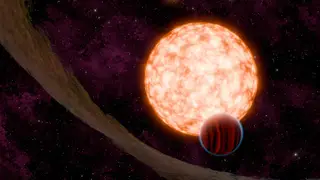
Researchers have discovered an exoplanet called GJ 3090 b that orbits its red dwarf star in the opposite direction from how it should have formed, defying conventional understanding of planetary system development. Unlike other known retrograde planets whose backward orbits can be explained by gravitational interactions with massive companion objects, this planetary system lacks any massive body that could account for such an unusual configuration. The discovery suggests scientists may need to reconsider their current models of how complex planetary systems around the galaxy's most common star types take shape.
M dwarfs represent the dominant stellar population throughout the galaxy, making up roughly three-quarters of all stars. Their small size and low luminosity make direct observation challenging, yet they host numerous planetary systems worthy of scientific study. The GJ 3090 system contains at least two planets, possibly three, all smaller than Neptune and orbiting within a 16-day period.
Researchers identified the retrograde orbit through transit photometry, observing ten distinct instances where the planet crossed its host star's disk. This technique measures variations in starlight to determine planetary characteristics and orbital parameters. The extreme misalignment detected in GJ 3090 b's trajectory represents one of the most unusual configurations discovered to date, suggesting formation mechanisms that current planetary science models cannot adequately explain.
Understanding exoplanet formation around M dwarfs could reshape planetary science education and refine models used to search for habitable worlds. This discovery may prompt astronomers to reconsider detection methods and theoretical frameworks, potentially opening new research directions. For the broader public, such findings underscore the complexity of cosmic system development and may influence long-term strategies for identifying potentially life-bearing exoplanets, though practical applications remain distant.