Astronomers Capture First Direct View of Gas Swirling Around Forming Planet
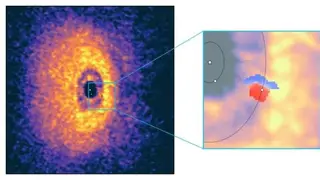
Researchers using the ALMA observatory have obtained the first direct image of a protoplanet embedded in swirling gas and dust, revealing planetary formation processes previously only visible through computer simulations. The discovery focuses on WISPIT 2b, a Jupiter-mass object located 430 light-years away, alongside its companion protoplanet WISPIT 2c, both of which are actively shaping their surrounding disk environment. The observation confirms theoretical predictions about how planets carve gaps and create swirling patterns as they form within their parent star's disk.
ALMA's radio dish array in Chile enabled researchers to achieve unprecedented resolution by combining signals from 66 separate instruments. This technological capability proved essential for detecting the faint emissions from distant protoplanetary systems. The WISPIT 2 system, located 430 light-years away, presented an ideal target because its two forming planets actively interact with their surrounding disk in ways that produce detectable signatures.
The discovery holds particular significance for understanding planetary assembly mechanisms. The visible distinction between how WISPIT 2c cleared its environment entirely versus how WISPIT 2b continues gathering material while creating gaps provides direct observational evidence for processes previously known only through theoretical models. This real-world confirmation could help refine existing formation theories and guide future observations of younger planetary systems.
This finding may accelerate progress in planetary science by validating computational models used to predict exoplanet characteristics and formation timelines. Such validation could improve astronomers' ability to identify potentially habitable worlds and assess the prevalence of planetary systems like our own. Educational institutions and space agencies may leverage this discovery to justify continued investment in advanced astronomical infrastructure. The broader public understanding of how planets form—and by extension, how common they might be—could shift perspectives on humanity's place in the universe.